

Neighbourhood Planning
Get in contactOur Neighbourhood Plan support
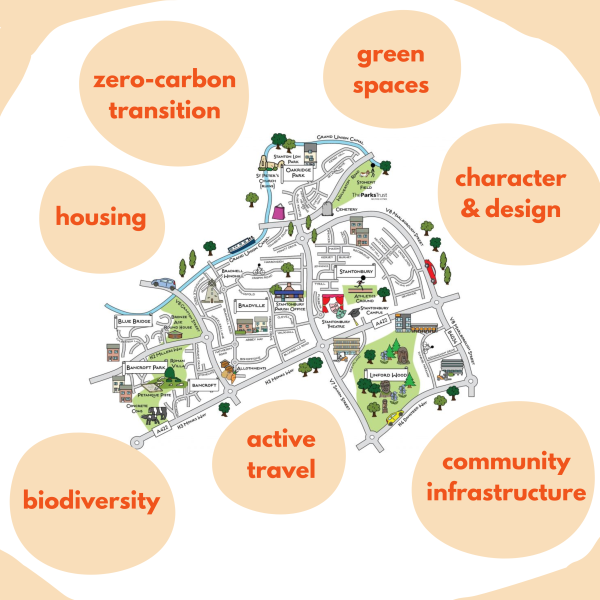
Neighbourhood Plans are an important tool for communities who want to get the most out of the planning system. They set out policies to achieve positive local impacts on topics such as housing, design, the zero-carbon transition, nature recovery and biodiversity, local green spaces and active travel.
Having supported over twenty Oxfordshire groups to develop a Neighbourhood Development Plan, our expert team of RTPI-accredited planners support on all aspects of the process, including baseline evidencing, consultation strategies, policy and statement drafting, and design codes.
If you’re interested in discussing our neighbourhood planning services with a member of the team, get in contact with us for more information.
“
Community First Oxfordshire has offered us valuable guidance and mentoring throughout the Neighbourhood Plan process. Without them it would have been virtually impossible to reach our objective. We have no hesitation in recommending them to any organisation who may require their expertise.
Brize Norton Neighbourhood Plan Steering Group
What is a Neighbourhood Plan?
Themes addressed in a Neighbourhood Plan
How we turn a vision into policies
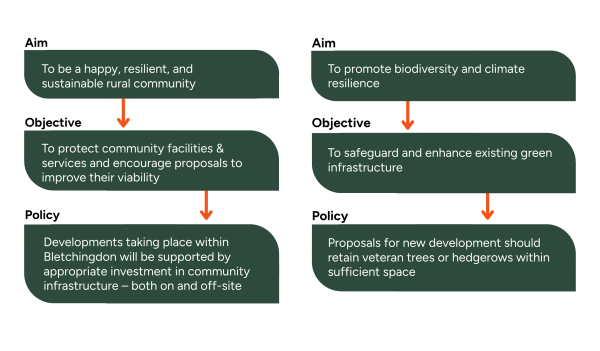
Example: Brize Norton Neighbourhood Plan
Brize Norton’s vision is: To support sustainable development that meets the needs of residents now and in the future, while retaining Brize Norton’s separate identity as a rural parish adjacent to, but separate from, the town of Carterton. To protect and where possible enhance our rural environment whilst also acknowledging that RAF Brize Norton will have an ongoing influence over certain elements of our lifestyle.
They identified the following key priorities:
- Protecting important green spaces and green corridors
- Encouraging wildlife and biodiversity
- Climate change including an increased risk of flooding
- Future housing development
- Ensuring good levels of connectivity including to the open countryside
- Traffic, road-use, and parking
- Out-commuting and a lack of opportunities for local job creation
- Protection and provision of community services and assets
- Protection of Parish character and heritage
- Protecting the rural setting and landscape of the village
- Coalescence with Carterton
Read the full plan
Example: East Hanney Neighbourhood Plan
Our vision is to ensure that East Hanney remains as an attractive Lowland Vale parish where any new development reflects and enhances the sense of place. We want the strong sense of community to be maintained and thus expect community facilities to be improved, expanded, or provided anew to match the growing population.
The effects of climate change are likely to increase the probability of flooding, which is already a major concern, so our vision is for reduced risk of flooding through a variety of means including improved drainage systems.
Our population is predominantly in an older age range, the village also attracting families and people of all ages, so our vision is to provide housing, infrastructure and facilities that meet the needs of the wide range of ages and abilities, including those who are less able.
Our long history is continually being discovered as new archaeological finds are being uncovered, this includes roman coins, civil war lead shot and First World War cap badges found in 2017. Our vision is that opportunities for discovering more about our past village are encouraged and not prevented by future development.
Read the full plan
Example: Milton-under-Wychwood- Neighbourhood Plan
Milton-under-Wychwood’s plan identifies the following priorities:
Character and Heritage
- Enhance our strong sense of community spirit and local identity
- Conserve and, where possible, enhance the rural character of MuW and its surrounding countryside
- Maintain the discrete identity of the village of MuW and the adjacent hamlet of Upper Milton, each of these villages having their own distinct character within the Parish
- Maintain the separation of MuW from its neighbour Shipton-under-Wychwood.
Environment
- Conserve and enhance biodiversity and seek environmental improvements
- Conserve the high-quality and accessible countryside setting of the Parish, open landscapes and key views
- Protect important green spaces of high amenity and biodiversity value from development
- Protect local aquatic corridors from land use change.
Facilities and Infrastructure
- Protect community facilities and services from unnecessary loss and encourage proposals to sustain and improve their viability
- Nurture and support existing local services
- Convert underutilised buildings into premises for small businesses and shared workspaces.
Transport and Movement
- Promote healthier lifestyles by maximising opportunities for walking and cycling through suitable infrastructure
- Protect, improve and extend the PROW network for promotion of walking, riding and cycling (where approved) for health and general wellbeing.
Read the full plan
Map of our Neighbourhood Plans
Wild Oxfordshire

We work in partnership with Wild Oxfordshire to ensure neighbourhood plans embed nature recovery and biodiversity. Wild Oxfordshire can also provide a range of support services, including ecological surveys and management advice for local green spaces.
If your community is interested in delivering nature recovery within a Neighbourhood Plan, reach out to us for more information.
“
As a community volunteer running a Neighbourhood Plan, the support provided by Community First Oxfordshire has been a lifeline.
Warborough & Shillingford Neighbourhood Plan Steering Group
Resources
You can access tailored resources below, or head to our resource library to browse all of Community First Oxfordshire’s open access materials.
Neighbourhood Planning in a Climate Emergency
From the Centre for Sustainable Energy
Neighbourhood Planning: A Simple Guide for Councillors
From the Local Government Association.
Get in contact
Fill out the form below and our team will get back to you